 Engagement pour la fondation des hôpitaux indiens
Comment participer
Nous serions honorés de vous compter parmi nous lors de l’un des prochains engagements en personne près de chez vous. Les lieux des engagements à venir sont indiqués ci-dessous. Toutefois, si vous ne pouvez pas assister en personne ou préférez ne pas le faire, M. DeGagné sera ravi de recevoir vos commentaires par l’un des moyens suivants :
Formulaire de contribution en ligne
Écrivez-nous
Appelez-nous sans frais au
1-833-977-5668 et laissez un message vocal. Nous vous rappellerons rapidement.
Écrivez-nous
Engagement pour la fondation des hôpitaux indiens, C.P. 30 068, Gatineau RPO Montclair (QC) J8Y 0B4
Engagements à venir
Des séances de consultation auront lieu en Ontario, au Québec (Nunavik), au Manitoba, en Saskatchewan, en Alberta, en Colombie-Britannique, au Yukon, dans les Territoires du Nord-Ouest et au Nunavut. Si vous ne trouvez pas pour l'instant de communauté près de chez vous, vérifier plus tard, car de nouveaux lieux seront ajoutés au fil du temps. Pour rester informé des prochaines séances de consultation, veuillez nous envoyer un courriel à info@ihfes.ca.
Vous trouverez ci-dessous une liste des prochaines séances d’engagements. Au cours des prochains mois, de nombreuses séances en personne seront organisées d’un océan à l’autre. Si vous ne trouvez pas de séance près de votre communauté, veuillez revenir consulter cette page plus tard, car la liste sera régulièrement mise à jour avec de nouveaux lieux. Si vous avez des questions concernant les lieux des séances d'engagement actuels ou futurs, veuillez nous envoyer un courriel directement à info@ihfes.ca.
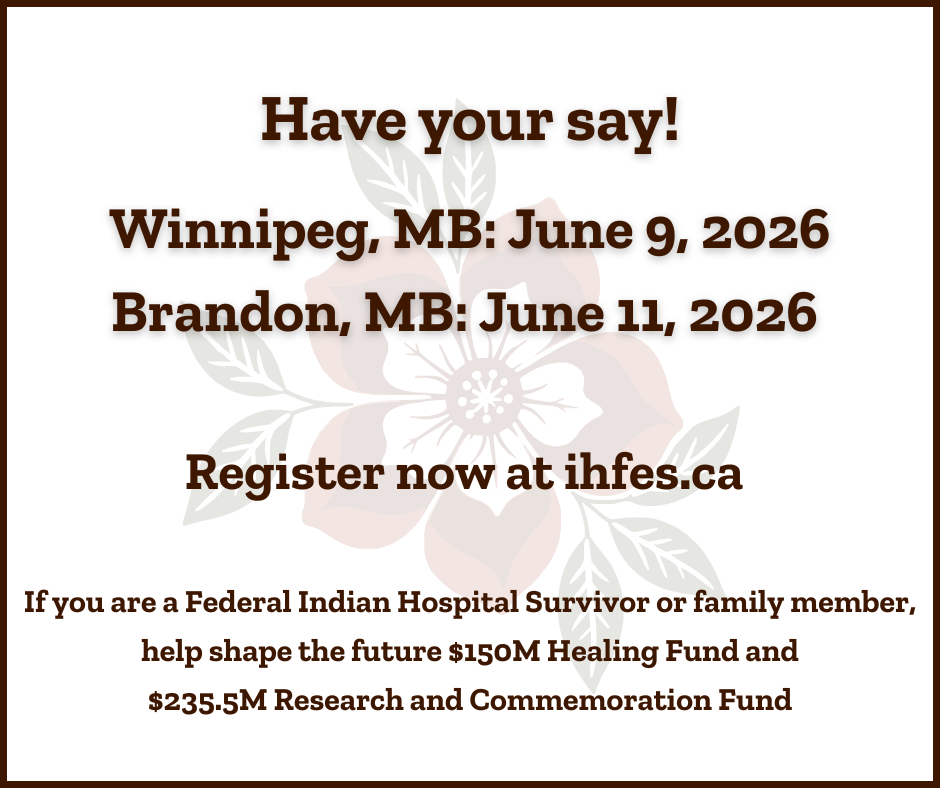
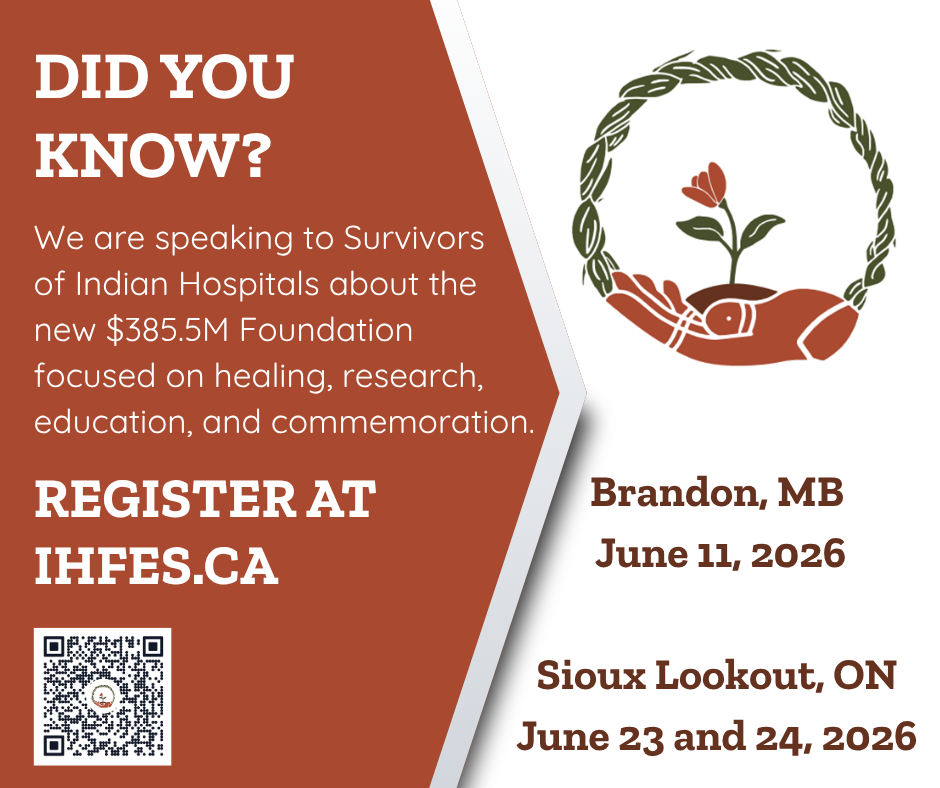
Fort Qu’Apelle, Saskatchewan — 10 septembre 2026
Yellowknife, Northwest Territories — 22 septembre 2026
Kuujjuarapik, Quebec — 05 octobre 2026
Inukjuak, Quebec — 07 octobre 2026
Salluit, Quebec — 09 octobre 2026
Six Nations, Ontario — 20 octobre 2026
Six Nations, Ontario — 21 octobre 2026
The Pas, Manitoba — 10 novembre 2026
Norway House First Nation, Manitoba — 12 novembre 2026
Norway House First Nation, Manitoba — 13 novembre 2026
Moose Factory, Ontario — 25 novembre 2026
Moose Factory, Ontario — 26 novembre 2026
Calgary, Alberta — 15 décembre 2026
Siksika, Alberta — 17 décembre 2026
La participation en personne est volontaire et aucune compensation financière ne sera accordée. Cependant, certains frais de déplacement peuvent être pris en charge pour les participants inscrits. Les participants doivent s’inscrire à une séance de participation pour pouvoir assister en personne. Veuillez ne pas vous présenter sans inscription préalable afin de garantir la disponibilité des espaces et des services nécessaires au nombre de participants. Après votre inscription, nous vous fournirons des informations détaillées sur les séances d’information et leur déroulement.
Inscrivez-vous ici
Ce formulaire d’inscription vous permet de participer à des rencontres en personne destinées aux survivants des hôpitaux fédéraux indiens visés par l’Entente de règlement et à leurs familles. Chaque engagement sera dirigé par des Autochtones et axé sur les survivants. Veuillez-vous inscrire à un seul engagement en personne. Afin de permettre à chacun de participer pleinement, le nombre de places est limité. Nous souhaitons permettre au plus grand nombre possible de personnes de partager leurs voix et de se faire entendre.
Lors de ces séances animées, les participants seront invités à fournir des contributions concernant la création d’une fondation dédiée à la guérison et au bien-être, à l’éducation, à la recherche, à la commémoration, à la préservation de l’histoire, à la protection des langues et à la localisation des sites d’inhumation associés aux hôpitaux fédéraux indiens. Chaque séance se déroulera dans le respect des protocoles culturels. Un accompagnement par des Aînés et un soutien psychologique adaptés aux réalités culturelles seront offerts gratuitement à tous les participants.
Pour les survivants et les membres de la famille qui ne peuvent pas ou ne souhaitent pas assister à une séance en personne, ou si vous avez d’autres réflexions à partager après avoir participé à un engagement, vous pouvez nous faire part de vos commentaires via notre formulaire de contribution en ligne, par courriel, par courrier postal ou par téléphone.
Formulaire d’inscription pour la séance d’engagement en personne
Les champs marqués d'un * sont obligatoires.
Résumé des engagements
Des notes manuscrites détaillées seront prises lors de chaque séance. Bien que toutes les notes prises seront utilisées par M. DeGagné pour préparer le plan de la fondation ou tout rapport sur les séances d’engagement, des résumés des commentaires reçus à chaque séance seront partagés dans cette section.
Indian Hospital Foundation
Engagement Record
Winnipeg, Manitoba
10 juin 2026
Session type:
879t78
Venue:
u9o
1. Session Orientation
This engagement session was held in Winnipeg, Manitoba on June 9, 2026 as part of the Federal Indian Hospitals Foundation engagement process. The session was conducted as a roundtable. It opened with the sharing of medicines and prayer led by Elders, followed by participant self-introductions, an overview of the Settlement Agreement, including the engagement process in support of the creation of a future Foundation, facilitated discussion, and closing remarks by Elders. Participants shared first-person accounts of experiences connected to Indian Hospitals and related institutions, together with reflections, advice, and priorities related to the proposed Foundation. Input was a mix of personal narrative and recommendations.
2. Thematically Grouped Comments and Advice
Records, Documentation, and the Claims Process
• Many records from Indian Hospitals do not exist, were handwritten, or cannot be located, in some cases because buildings were destroyed or records were not kept.
• Individuals’ names may have been changed over time (e.g. through marriage) or been recorded differently by different institutions; in some cases, numbers were assigned to individuals, making records difficult to trace.
• Difficulty obtaining personal medical records, including records requested but reported as not existing.
• Claims administrators require support; in previous claims processes e.g., Federal Indian Day Schools and Residential Schools, many people did not realize they were eligible; claims should have remained open longer.
• Role of records in recognizing experiences and supporting access to the claims process.
Experiences in Indian Hospitals and Related Institutions
• First-person narratives of being taken from their families as children and placed in Indian Hospitals and sanatoria.
• Accounts of restrictive conditions, including extended confinement, force-feeding, and separation from family and community.
• Descriptions of experiences of abuse and mistreatment within hospital settings.
• Connections between these experiences and the Indian Residential Schools and Indian Day Schools attended by participants and their families.
• Reflections on the lasting effects of these experiences, including across generations.
Healing, Mental Health, and Wellness
• The need for comprehensive, sustained mental health and addiction supports, including in communities further north.
• Land-based and culturally grounded healing approaches were priorities identified, including teaching people to live off the land.
• Importance of follow-up and ongoing support for those who share their experiences.
• Connection between healing and the mind, body, and culture.
Culture, Language, Identity, and Connection to Land
• Culture as a way of life, including teachings from Elders, family, and the land.
• Transmission of practices to children, including making igloos, preparing dried meat and smoked fish, and harvesting.
• Identity was connected to healing and described as foundational.
• Importance of Indigenous languages, including in institutional settings.
Healthcare Access, Systemic Racism, and Indigenous-Led Care
• Descriptions of racism within the healthcare system, including in treatment and staffing.
• Barriers to healthcare access for northern and remote communities, including travel for dialysis and treatment due to a lack of local technicians.
• The need for Indigenous-led primary care and Indigenous staff on the front line, including to explain medications to patients at discharge, especially in their Indigenous languages.
• The need to retain people in care rather than discharging them prematurely.
Commemoration, Research, and Preservation of History
• Commemoration options, including buildings, plaques, and a museum dedicated to the history of Indian hospitals.
• Preserving history through linking archives and records.
• Locating burial sites and recognizing unmarked graves connected to hospitals as a priority.
• Suggestions included naming a medical school, or units in hospital, e.g., dialysis unit, as a legacy and documenting stories and testimonies across regions.
• Participants noted that the general public is unaware of the segregated Hospital system that existed for Indigenous people; and education about the history of Indian hospitals is part of prevention.
Youth, Education, and Future Generations
• Participants encouraged programs supporting Indigenous youth entering healthcare and other fields.
• Supporting and funding students, including those pursuing higher education, especially in the sciences; and concerns about funding-eligibility rules.
• Focusing on ensuring conditions are better for future generations, including providing opportunity for children to participate in land-based learning.
Foundation Design, Funding, and Governance
• The Foundation’s funding model, including questions about spending only the interest versus spending the fund over a defined period.
• Recommendation to provide honoraria for engagement participants, and to pay people for their knowledge.
• Comparisons were drawn to the former Aboriginal Healing Foundation (AHF), including its funding and duration.
• Need for Elder involvement, Survivors/descendants, and regional representation in the Foundation’s work.
• The sustainability and longevity of the Foundation, including the view that it will outlive current participants, thus the need for legacy investments.
• Questions about whether all affected hospitals – not only the Hospitals under the Settlement Agreement – are included.
Northern and Remote Communities
• Communities further north require dedicated resources, including for mental health, harvesting, and cultural programming.
• Meetings are often held in larger centres (e.g. Iqaluit, Yellowknife) and more northern and remote participants can be disadvantaged.
• Request that materials be provided in advance of engagement sessions to support informed participation.
• The distinct experiences and circumstances of Inuit, and Northern communities.
3. Select Participant Quotes
Quote (Verbatim)
“We help one another, because it’s not easy to carry the harms that have been done to us”
“Coming together in a workshop like this is part of a healing process”
“We had nothing but we weren’t poor”
“The biggest issue facing Indigenous people is identity”
“We are here because the suffering needs to end somewhere”
“I would really like to see Elders be part of all this work”
“ ‘All across Canada’ must include Northwest Territories, Yukon and Nunavut. They don’t get the attention of others further down South”
“I’m thankful we survived, all of us”
“We want to expose our kids and grandkids to a beautiful way of life – out in the bush, out on the land, out on the water”
“Every experience that creates trauma happened at that place”
“I bear the scars of what they did to me”
“We as Indigenous people were treated with genocide”
“You can’t put a cap on our stories, our experiences, our pain”
“We live so far away and we feel like we are forgotten”
“We should support Indigenous students interested in medical careers enrolled in second and third degrees, especially in sciences, because those are so much harder to fund than first degrees”
“We are responsible for ourselves – to make a difference in our own life”
“We will be gone before all the funding is gone – the Foundation will outlive us”
“Education has to be part of this process but it has to come from Indigenous people”
“You need lots of passion and patience to work with Indigenous people because they are hurting so much”
“We should support the whole of people’s healing path because it takes many different journeys”
“Sometimes we forget gratitude because we are in such much pain from memories”
4. Key Takeaways
• The absence or loss of records was a recurring concern, affecting both recognition of experiences and access to the claims process.
• The importance of Indigenous-led healing — including land-based and culturally grounded approaches — alongside sustained mental health and addiction supports.
• Racism within the healthcare system and barriers to healthcare access, particularly for northern and remote communities.
• Indigenous staffing, Indigenous-led primary care, and supporting youth to enter healthcare fields.
• Commemoration, preservation of history, and locating/recognizing burial sites connected to hospitals were priorities.
• Education about the history of Indian Hospitals as part of prevention.
• Elder involvement, leadership, regional representation, and questions about the Foundation’s funding model and longevity were important considerations in discussions of its design.
• Northern and remote communities require dedicated resources and consideration, including advance materials and culturally grounded programming.
5. Gallery
1 of 2
2 of 2
Indian Hospital Foundation
Engagement Record
Session type:
huouyo
Venue:
t8i68
1. Session Orientation
This engagement session was held i Winnipeg, Manitoba on June 9, 2026 as part of the Federal Indian Hospitals Foundation engagement process. The session was conducted as a roundtable. It opened with the sharing of medicines and prayer led by Elders, followed by participant self-introductions, an overview of the Settlement Agreement, including the engagement process in support of the creation of a future Foundation, facilitated discussion, and closing remarks by Elders. Participants shared first-person accounts of experiences connected to Indian Hospitals and related institutions, together with reflections, advice, and priorities related to the proposed Foundation. Input was a mix of personal narrative and recommendations.
2. Thematically Grouped Comments and Advice
Records, Documentation, and the Claims Process
• Many records from Indian Hospitals do not exist, were handwritten, or cannot be located, in some cases because buildings were destroyed or records were not kept.
• Individuals’ names may have been changed over time (e.g. through marriage) or been recorded differently by different institutions; in some cases, numbers were assigned to individuals, making records difficult to trace.
• Difficulty obtaining personal medical records, including records requested but reported as not existing.
• Claims administrators require support; in previous claims processes e.g., Federal Indian Day Schools and Residential Schools, many people did not realize they were eligible; claims should have remained open longer.
• Role of records in recognizing experiences and supporting access to the claims process.
Experiences in Indian Hospitals and Related Institutions
• First-person narratives of being taken from their families as children and placed in Indian Hospitals and sanatoria.
• Accounts of restrictive conditions, including extended confinement, force-feeding, and separation from family and community.
• Descriptions of experiences of abuse and mistreatment within hospital settings.
• Connections between these experiences and the Indian Residential Schools and Indian Day Schools attended by participants and their families.
• Reflections on the lasting effects of these experiences, including across generations.
Healing, Mental Health, and Wellness
• The need for comprehensive, sustained mental health and addiction supports, including in communities further north.
• Land-based and culturally grounded healing approaches were priorities identified, including teaching people to live off the land.
• Importance of follow-up and ongoing support for those who share their experiences.
• Connection between healing and the mind, body, and culture.
Culture, Language, Identity, and Connection to Land
• Culture as a way of life, including teachings from Elders, family, and the land.
• Transmission of practices to children, including making igloos, preparing dried meat and smoked fish, and harvesting.
• Identity was connected to healing and described as foundational.
• Importance of Indigenous languages, including in institutional settings.
Healthcare Access, Systemic Racism, and Indigenous-Led Care
• Descriptions of racism within the healthcare system, including in treatment and staffing.
• Barriers to healthcare access for northern and remote communities, including travel for dialysis and treatment due to a lack of local technicians.
• The need for Indigenous-led primary care and Indigenous staff on the front line, including to explain medications to patients at discharge, especially in their Indigenous languages.
• The need to retain people in care rather than discharging them prematurely.
Commemoration, Research, and Preservation of History
• Commemoration options, including buildings, plaques, and a museum dedicated to the history of Indian hospitals.
• Preserving history through linking archives and records.
• Locating burial sites and recognizing unmarked graves connected to hospitals as a priority.
• Suggestions included naming a medical school, or units in hospital, e.g., dialysis unit, as a legacy and documenting stories and testimonies across regions.
• Participants noted that the general public is unaware of the segregated Hospital system that existed for Indigenous people; and education about the history of Indian hospitals is part of prevention.
Youth, Education, and Future Generations
• Participants encouraged programs supporting Indigenous youth entering healthcare and other fields.
• Supporting and funding students, including those pursuing higher education, especially in the sciences; and concerns about funding-eligibility rules.
• Focusing on ensuring conditions are better for future generations, including providing opportunity for children to participate in land-based learning.
Foundation Design, Funding, and Governance
• The Foundation’s funding model, including questions about spending only the interest versus spending the fund over a defined period.
• Recommendation to provide honoraria for engagement participants, and to pay people for their knowledge.
• Comparisons were drawn to the former Aboriginal Healing Foundation (AHF), including its funding and duration.
• Need for Elder involvement, Survivors/descendants, and regional representation in the Foundation’s work.
• The sustainability and longevity of the Foundation, including the view that it will outlive current participants, thus the need for legacy investments.
• Questions about whether all affected hospitals – not only the Hospitals under the Settlement Agreement – are included.
Northern and Remote Communities
• Communities further north require dedicated resources, including for mental health, harvesting, and cultural programming.
• Meetings are often held in larger centres (e.g. Iqaluit, Yellowknife) and more northern and remote participants can be disadvantaged.
• Request that materials be provided in advance of engagement sessions to support informed participation.
• The distinct experiences and circumstances of Inuit, and Northern communities.
3. Select Participant Quotes
Quote (Verbatim)
“We help one another, because it’s not easy to carry the harms that have been done to us”
“Coming together in a workshop like this is part of a healing process”
“We had nothing but we weren’t poor”
“The biggest issue facing Indigenous people is identity”
“We are here because the suffering needs to end somewhere”
“I would really like to see Elders be part of all this work”
“ ‘All across Canada’ must include Northwest Territories, Yukon and Nunavut. They don’t get the attention of others further down South”
“I’m thankful we survived, all of us”
“We want to expose our kids and grandkids to a beautiful way of life – out in the bush, out on the land, out on the water”
“Every experience that creates trauma happened at that place”
“I bear the scars of what they did to me”
“We as Indigenous people were treated with genocide”
“You can’t put a cap on our stories, our experiences, our pain”
“We live so far away and we feel like we are forgotten”
“We should support Indigenous students interested in medical careers enrolled in second and third degrees, especially in sciences, because those are so much harder to fund than first degrees”
“We are responsible for ourselves – to make a difference in our own life”
“We will be gone before all the funding is gone – the Foundation will outlive us”
“Education has to be part of this process but it has to come from Indigenous people”
“You need lots of passion and patience to work with Indigenous people because they are hurting so much”
“We should support the whole of people’s healing path because it takes many different journeys”
“Sometimes we forget gratitude because we are in such much pain from memories”
4. Key Takeaways
• The absence or loss of records was a recurring concern, affecting both recognition of experiences and access to the claims process.
• The importance of Indigenous-led healing — including land-based and culturally grounded approaches — alongside sustained mental health and addiction supports.
• Racism within the healthcare system and barriers to healthcare access, particularly for northern and remote communities.
• Indigenous staffing, Indigenous-led primary care, and supporting youth to enter healthcare fields.
• Commemoration, preservation of history, and locating/recognizing burial sites connected to hospitals were priorities.
• Education about the history of Indian Hospitals as part of prevention.
• Elder involvement, leadership, regional representation, and questions about the Foundation’s funding model and longevity were important considerations in discussions of its design.
• Northern and remote communities require dedicated resources and consideration, including advance materials and culturally grounded programming.
Indian Hospital Foundation
Engagement Record
Session type:
Engagement Session
Venue:
Anish Centre, Winnipeg, MB
1. Session Orientation
This engagement session was held in Winnipeg, Manitoba on June 9, 2026 as part of the Federal Indian Hospitals Foundation engagement process. The session was conducted as a roundtable. It opened with the sharing of medicines and prayer led by Elders, followed by participant self-introductions, an overview of the Settlement Agreement, including the engagement process in support of the creation of a future Foundation, facilitated discussion, and closing remarks by Elders. Participants shared first-person accounts of experiences connected to Indian Hospitals and related institutions, together with reflections, advice, and priorities related to the proposed Foundation. Input was a mix of personal narrative and recommendations.
2. Thematically Grouped Comments and Advice
Records, Documentation, and the Claims Process
• Many records from Indian Hospitals do not exist, were handwritten, or cannot be located, in some cases because buildings were destroyed or records were not kept.
• Individuals’ names may have been changed over time (e.g. through marriage) or been recorded differently by different institutions; in some cases, numbers were assigned to individuals, making records difficult to trace.
• Difficulty obtaining personal medical records, including records requested but reported as not existing.
• Claims administrators require support; in previous claims processes e.g., Federal Indian Day Schools and Residential Schools, many people did not realize they were eligible; claims should have remained open longer.
• Role of records in recognizing experiences and supporting access to the claims process.
• Claims administrators require support; in previous claims processes e.g., Federal Indian Day Schools and Residential Schools, many people did not realize they were eligible; claims should have remained open longer.
• Role of records in recognizing experiences and supporting access to the claims process.
Experiences in Indian Hospitals and Related Institutions
• First-person narratives of being taken from their families as children and placed in Indian Hospitals and sanatoria.
• Accounts of restrictive conditions, including extended confinement, force-feeding, and separation from family and community.
• Descriptions of experiences of abuse and mistreatment within hospital settings.
• Connections between these experiences and the Indian Residential Schools and Indian Day Schools attended by participants and their families.
• Reflections on the lasting effects of these experiences, including across generations.
• First-person narratives of being taken from their families as children and placed in Indian Hospitals and sanatoria.
• Accounts of restrictive conditions, including extended confinement, force-feeding, and separation from family and community.
• Descriptions of experiences of abuse and mistreatment within hospital settings.
• Connections between these experiences and the Indian Residential Schools and Indian Day Schools attended by participants and their families.
• Reflections on the lasting effects of these experiences, including across generations.
Healing, Mental Health, and Wellness
• The need for comprehensive, sustained mental health and addiction supports, including in communities further north.
• Land-based and culturally grounded healing approaches were priorities identified, including teaching people to live off the land.
• Importance of follow-up and ongoing support for those who share their experiences.
• Connection between healing and the mind, body, and culture.
• The need for comprehensive, sustained mental health and addiction supports, including in communities further north.
• Land-based and culturally grounded healing approaches were priorities identified, including teaching people to live off the land.
• Importance of follow-up and ongoing support for those who share their experiences.
• Connection between healing and the mind, body, and culture.
Culture, Language, Identity, and Connection to Land
• Culture as a way of life, including teachings from Elders, family, and the land.
• Transmission of practices to children, including making igloos, preparing dried meat and smoked fish, and harvesting.
• Identity was connected to healing and described as foundational.
• Importance of Indigenous languages, including in institutional settings.
• Culture as a way of life, including teachings from Elders, family, and the land.
• Transmission of practices to children, including making igloos, preparing dried meat and smoked fish, and harvesting.
• Identity was connected to healing and described as foundational.
• Importance of Indigenous languages, including in institutional settings.
Healthcare Access, Systemic Racism, and Indigenous-Led Care
• Descriptions of racism within the healthcare system, including in treatment and staffing.
• Barriers to healthcare access for northern and remote communities, including travel for dialysis and treatment due to a lack of local technicians.
• The need for Indigenous-led primary care and Indigenous staff on the front line, including to explain medications to patients at discharge, especially in their Indigenous languages.
• The need to retain people in care rather than discharging them prematurely.
• Descriptions of racism within the healthcare system, including in treatment and staffing.
• Barriers to healthcare access for northern and remote communities, including travel for dialysis and treatment due to a lack of local technicians.
• The need for Indigenous-led primary care and Indigenous staff on the front line, including to explain medications to patients at discharge, especially in their Indigenous languages.
• The need to retain people in care rather than discharging them prematurely.
Commemoration, Research, and Preservation of History
• Commemoration options, including buildings, plaques, and a museum dedicated to the history of Indian hospitals.
• Preserving history through linking archives and records.
• Locating burial sites and recognizing unmarked graves connected to hospitals as a priority.
• Suggestions included naming a medical school, or units in hospital, e.g., dialysis unit, as a legacy and documenting stories and testimonies across regions.
• Participants noted that the general public is unaware of the segregated Hospital system that existed for Indigenous people; and education about the history of Indian hospitals is part of prevention.
• Commemoration options, including buildings, plaques, and a museum dedicated to the history of Indian hospitals.
• Preserving history through linking archives and records.
• Locating burial sites and recognizing unmarked graves connected to hospitals as a priority.
• Suggestions included naming a medical school, or units in hospital, e.g., dialysis unit, as a legacy and documenting stories and testimonies across regions.
• Participants noted that the general public is unaware of the segregated Hospital system that existed for Indigenous people; and education about the history of Indian hospitals is part of prevention.
Youth, Education, and Future Generations
• Participants encouraged programs supporting Indigenous youth entering healthcare and other fields.
• Supporting and funding students, including those pursuing higher education, especially in the sciences; and concerns about funding-eligibility rules.
• Focusing on ensuring conditions are better for future generations, including providing opportunity for children to participate in land-based learning.
• Participants encouraged programs supporting Indigenous youth entering healthcare and other fields.
• Supporting and funding students, including those pursuing higher education, especially in the sciences; and concerns about funding-eligibility rules.
• Focusing on ensuring conditions are better for future generations, including providing opportunity for children to participate in land-based learning.
Foundation Design, Funding, and Governance
• The Foundation’s funding model, including questions about spending only the interest versus spending the fund over a defined period.
• Recommendation to provide honoraria for engagement participants, and to pay people for their knowledge.
• Comparisons were drawn to the former Aboriginal Healing Foundation (AHF), including its funding and duration.
• Need for Elder involvement, Survivors/descendants, and regional representation in the Foundation’s work.
• The sustainability and longevity of the Foundation, including the view that it will outlive current participants, thus the need for legacy investments.
• Questions about whether all affected hospitals – not only the Hospitals under the Settlement Agreement – are included.
• The Foundation’s funding model, including questions about spending only the interest versus spending the fund over a defined period.
• Recommendation to provide honoraria for engagement participants, and to pay people for their knowledge.
• Comparisons were drawn to the former Aboriginal Healing Foundation (AHF), including its funding and duration.
• Need for Elder involvement, Survivors/descendants, and regional representation in the Foundation’s work.
• The sustainability and longevity of the Foundation, including the view that it will outlive current participants, thus the need for legacy investments.
• Questions about whether all affected hospitals – not only the Hospitals under the Settlement Agreement – are included.
Northern and Remote Communities
• Communities further north require dedicated resources, including for mental health, harvesting, and cultural programming.
• Meetings are often held in larger centres (e.g. Iqaluit, Yellowknife) and more northern and remote participants can be disadvantaged.
• Request that materials be provided in advance of engagement sessions to support informed participation.
• The distinct experiences and circumstances of Inuit, and Northern communities.
• Communities further north require dedicated resources, including for mental health, harvesting, and cultural programming.
• Meetings are often held in larger centres (e.g. Iqaluit, Yellowknife) and more northern and remote participants can be disadvantaged.
• Request that materials be provided in advance of engagement sessions to support informed participation.
• The distinct experiences and circumstances of Inuit, and Northern communities.
3. Select Participant Quotes
Quote (Verbatim)
“We help one another, because it’s not easy to carry the harms that have been done to us”
“Coming together in a workshop like this is part of a healing process”
“We are here because the suffering needs to end somewhere”
“I would really like to see Elders be part of all this work”
“ ‘All across Canada’ must include Northwest Territories, Yukon and Nunavut. They don’t get the attention of others further down South”
“I’m thankful we survived, all of us”
“We want to expose our kids and grandkids to a beautiful way of life – out in the bush, out on the land, out on the water”
“Every experience that creates trauma happened at that place”
“I bear the scars of what they did to me”
“We as Indigenous people were treated with genocide”
“You can’t put a cap on our stories, our experiences, our pain”
“We live so far away and we feel like we are forgotten”
“We should support Indigenous students interested in medical careers enrolled in second and third degrees, especially in sciences, because those are so much harder to fund than first degrees”
“We are responsible for ourselves – to make a difference in our own life”
“We will be gone before all the funding is gone – the Foundation will outlive us”
“Education has to be part of this process but it has to come from Indigenous people”
“You need lots of passion and patience to work with Indigenous people because they are hurting so much”
“We should support the whole of people’s healing path because it takes many different journeys”
“Sometimes we forget gratitude because we are in such much pain from memories”
4. Key Takeaways
• The absence or loss of records was a recurring concern, affecting both recognition of experiences and access to the claims process.
• The importance of Indigenous-led healing — including land-based and culturally grounded approaches — alongside sustained mental health and addiction supports.
• Racism within the healthcare system and barriers to healthcare access, particularly for northern and remote communities.
• Indigenous staffing, Indigenous-led primary care, and supporting youth to enter healthcare fields.
• Commemoration, preservation of history, and locating/recognizing burial sites connected to hospitals were priorities.
• Education about the history of Indian Hospitals as part of prevention.
• Elder involvement, leadership, regional representation, and questions about the Foundation’s funding model and longevity were important considerations in discussions of its design.
• Northern and remote communities require dedicated resources and consideration, including advance materials and culturally grounded programming.
• The importance of Indigenous-led healing — including land-based and culturally grounded approaches — alongside sustained mental health and addiction supports.
• Racism within the healthcare system and barriers to healthcare access, particularly for northern and remote communities.
• Indigenous staffing, Indigenous-led primary care, and supporting youth to enter healthcare fields.
• Commemoration, preservation of history, and locating/recognizing burial sites connected to hospitals were priorities.
• Education about the history of Indian Hospitals as part of prevention.
• Elder involvement, leadership, regional representation, and questions about the Foundation’s funding model and longevity were important considerations in discussions of its design.
• Northern and remote communities require dedicated resources and consideration, including advance materials and culturally grounded programming.
Indian Hospital Foundation
Engagement Record
Session type:
Roundtable engagement session
Venue:
Anish Healing Centre (Water Room)
1. Session Orientation
This engagement session was held in Winnipeg, Manitoba on June 9, 2026 as part of the Federal Indian Hospitals Foundation engagement process. The session was conducted as a roundtable. It opened with the sharing of medicines and prayer led by Elders, followed by participant self-introductions, an overview of the Settlement Agreement, including the engagement process in support of the creation of a future Foundation, facilitated discussion, and closing remarks by Elders. Participants shared first-person accounts of experiences connected to Indian Hospitals and related institutions, together with reflections, advice, and priorities related to the proposed Foundation. Input was a mix of personal narrative and recommendations.
2. Thematically Grouped Comments and Advice
Records, Documentation, and the Claims Process
• Many records from Indian Hospitals do not exist, were handwritten, or cannot be located, in some cases because buildings were destroyed or records were not kept.
• Individuals’ names may have been changed over time (e.g. through marriage) or been recorded differently by different institutions; in some cases, numbers were assigned to individuals, making records difficult to trace.
• Difficulty obtaining personal medical records, including records requested but reported as not existing.
• Claims administrators require support; in previous claims processes e.g., Federal Indian Day Schools and Residential Schools, many people did not realize they were eligible; claims should have remained open longer.
• Role of records in recognizing experiences and supporting access to the claims process.
Experiences in Indian Hospitals and Related Institutions
• First-person narratives of being taken from their families as children and placed in Indian Hospitals and sanatoria.
• Accounts of restrictive conditions, including extended confinement, force-feeding, and separation from family and community.
• Descriptions of experiences of abuse and mistreatment within hospital settings.
• Connections between these experiences and the Indian Residential Schools and Indian Day Schools attended by participants and their families.
• Reflections on the lasting effects of these experiences, including across generations.
Healing, Mental Health, and Wellness
• The need for comprehensive, sustained mental health and addiction supports, including in communities further north.
• Land-based and culturally grounded healing approaches were priorities identified, including teaching people to live off the land.
• Importance of follow-up and ongoing support for those who share their experiences.
• Connection between healing and the mind, body, and culture.
Culture, Language, Identity, and Connection to Land
• Culture as a way of life, including teachings from Elders, family, and the land.
• Transmission of practices to children, including making igloos, preparing dried meat and smoked fish, and harvesting.
• Identity was connected to healing and described as foundational.
• Importance of Indigenous languages, including in institutional settings.
Healthcare Access, Systemic Racism, and Indigenous-Led Care
• Descriptions of racism within the healthcare system, including in treatment and staffing.
• Barriers to healthcare access for northern and remote communities, including travel for dialysis and treatment due to a lack of local technicians.
• The need for Indigenous-led primary care and Indigenous staff on the front line, including to explain medications to patients at discharge, especially in their Indigenous languages.
• The need to retain people in care rather than discharging them prematurely.
Commemoration, Research, and Preservation of History
• Commemoration options, including buildings, plaques, and a museum dedicated to the history of Indian hospitals.
• Preserving history through linking archives and records.
• Locating burial sites and recognizing unmarked graves connected to hospitals as a priority.
• Suggestions included naming a medical school, or units in hospital, e.g., dialysis unit, as a legacy and documenting stories and testimonies across regions.
• Participants noted that the general public is unaware of the segregated Hospital system that existed for Indigenous people; and education about the history of Indian hospitals is part of prevention.
Youth, Education, and Future Generations
• Participants encouraged programs supporting Indigenous youth entering healthcare and other fields.
• Supporting and funding students, including those pursuing higher education, especially in the sciences; and concerns about funding-eligibility rules.
• Focusing on ensuring conditions are better for future generations, including providing opportunity for children to participate in land-based learning.
Foundation Design, Funding, and Governance
• The Foundation’s funding model, including questions about spending only the interest versus spending the fund over a defined period.
• Recommendation to provide honoraria for engagement participants, and to pay people for their knowledge.
• Comparisons were drawn to the former Aboriginal Healing Foundation (AHF), including its funding and duration.
• Need for Elder involvement, Survivors/descendants, and regional representation in the Foundation’s work.
• The sustainability and longevity of the Foundation, including the view that it will outlive current participants, thus the need for legacy investments.
• Questions about whether all affected hospitals – not only the Hospitals under the Settlement Agreement – are included.
Northern and Remote Communities
• Communities further north require dedicated resources, including for mental health, harvesting, and cultural programming.
• Meetings are often held in larger centres (e.g. Iqaluit, Yellowknife) and more northern and remote participants can be disadvantaged.
• Request that materials be provided in advance of engagement sessions to support informed participation.
• The distinct experiences and circumstances of Inuit, and Northern communities.
3. Select Participant Quotes
Quote (Verbatim)
“We help one another, because it’s not easy to carry the harms that have been done to us”
“Coming together in a workshop like this is part of a healing process”
“We had nothing but we weren’t poor”
“The biggest issue facing Indigenous people is identity”
“We are here because the suffering needs to end somewhere”
“I would really like to see Elders be part of all this work”
“ ‘All across Canada’ must include Northwest Territories, Yukon and Nunavut. They don’t get the attention of others further down South”
“I’m thankful we survived, all of us”
“We want to expose our kids and grandkids to a beautiful way of life – out in the bush, out on the land, out on the water”
“Every experience that creates trauma happened at that place”
“I bear the scars of what they did to me”
“We as Indigenous people were treated with genocide”
“You can’t put a cap on our stories, our experiences, our pain”
“We live so far away and we feel like we are forgotten”
“We should support Indigenous students interested in medical careers enrolled in second and third degrees, especially in sciences, because those are so much harder to fund than first degrees”
“We are responsible for ourselves – to make a difference in our own life”
“We will be gone before all the funding is gone – the Foundation will outlive us”
“Education has to be part of this process but it has to come from Indigenous people”
“You need lots of passion and patience to work with Indigenous people because they are hurting so much”
“We should support the whole of people’s healing path because it takes many different journeys”
“Sometimes we forget gratitude because we are in such much pain from memories”
4. Key Takeaways
• The absence or loss of records was a recurring concern, affecting both recognition of experiences and access to the claims process.
• The importance of Indigenous-led healing — including land-based and culturally grounded approaches — alongside sustained mental health and addiction supports.
• Racism within the healthcare system and barriers to healthcare access, particularly for northern and remote communities.
• Indigenous staffing, Indigenous-led primary care, and supporting youth to enter healthcare fields.
• Commemoration, preservation of history, and locating/recognizing burial sites connected to hospitals were priorities.
• Education about the history of Indian Hospitals as part of prevention.
• Elder involvement, leadership, regional representation, and questions about the Foundation’s funding model and longevity were important considerations in discussions of its design.
• Northern and remote communities require dedicated resources and consideration, including advance materials and culturally grounded programming.
5. Gallery
Processus préalable aux engagements
Avant de commencer le processus d’engagement officiel, l’équipe de soutien au processus d’engagement pour la fondation des hôpitaux indiens a organisé une série de rencontres informelles avec M. DeGagné, les survivants et leurs proches impliqués dans le litige et le processus de règlement. Les séances ont été conçues pour éclairer le processus d’engagement à l’échelle nationale. Les séances ont eu lieu de décembre 2025 à février 2026 à Edmonton, Saskatoon, Iqaluit et Vancouver.